As an Amazon Associate I earn from qualifying purchases.
Updated November 2026
Dining room art wall decor works best when the pieces suit the room’s scale, the table below them and the way you actually use the space. This guide walks you through choosing artwork, sizing it, planning a layout and hanging it securely, so the final result looks deliberate rather than crowded or random.
Start by Measuring Your Dining Room Wall
Before you shop, measure the wall where the art will go. Note the width and height of the wall, the location of any windows, outlets, light switches or sideboards, and the size of your table. A common guideline is to leave about 6 to 8 inches between the top of a dining chair back and the bottom of a piece hung above a sideboard, though you should adjust this to fit your own furniture. Use painter’s tape to outline potential art sizes on the wall so you can see proportions before committing to a hole.
Shopping for one? See our guide: 10 Best Wall Decor for Living Rooms, Bedrooms and Bathrooms.
Choose Art That Matches the Room’s Mood
Dining rooms are gathering spaces, so the artwork should support conversation rather than compete with it. Large abstract canvases, botanical prints, framed photography and vintage maps all work well, as long as the color palette ties into the walls, rug or table. Consider how the room is lit as well. Pieces with glass glazing can reflect overhead fixtures, so matte finishes or non-glare glass are often easier to live with in a room used for evening meals.
Plan a Layout Before You Hang Anything
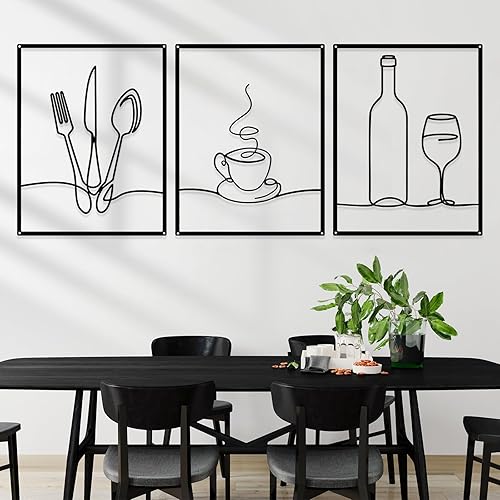
Most dining room walls look best with one of three layouts: a single large piece, a balanced grouping or a gallery arrangement. A single piece should cover roughly two-thirds to three-quarters of the wall or furniture width beneath it. Groupings should be arranged on a shared visual line, with spacing between frames of about 2 to 3 inches. Lay the pieces out on the floor first, photograph the arrangement and check it from the doorway and from a seated position at the table.
Hang the Art at the Right Height
For art above a sideboard or buffet, the center of the artwork usually sits at about 57 to 60 inches from the floor, which is the standard gallery-height guideline. If the piece hangs above a sideboard, the bottom edge typically falls 8 to 12 inches above the furniture. Mark your points with a level and a pencil, then confirm that the hanging hardware matches the weight of the piece and the wall type. For heavier frames, follow a proper process for securing anchors and studs; our guide on how to hang heavy wall art safely covers those steps in detail.
Tools and Supplies to Have on Hand
- Tape measure and pencil
- Level (a laser level speeds up multi-piece layouts)
- Painter’s tape and kraft paper for templates
- Stud finder
- Picture hanging hardware rated above the piece’s weight
- Drill with appropriate bits, if anchors are needed
Common Mistakes to Avoid
- Hanging art too high. Pieces that float far above a table feel disconnected. Keep the visual link between the art and the furniture.
- Choosing art that is too small. Small frames on a large wall look lost. Scale up or group pieces together.
- Ignoring lighting. Dark corners and glare both hurt the piece. Test with the room’s actual lights at night.
- Mismatched frames without a reason. A deliberate mix can look great, but random frame styles often feel cluttered. Pick a shared element such as color, metal finish or frame depth.
- Skipping the template. Marking holes directly on the wall leads to errors. Paper templates let you move pieces before you commit.
Tips for a Finished Look
Repeat one color from the art elsewhere in the room, such as in a throw pillow, a runner or a candle holder, to make the wall feel connected to the space. If you are also updating the lighting, the placement of a fixture can change how the art reads at night. Compare options in our article on pendant lights vs chandeliers to see how each style affects the room’s focal points. You may also want to browse wall decor ideas for living rooms, bedrooms and bathrooms for inspiration on scale and framing that carries across rooms.
Recommended gear
- Laser level: helps keep multi-piece gallery layouts straight across a long wall. View on Amazon
- Stud finder: locates framing so heavier pieces can be anchored into solid wood rather than drywall alone. View on Amazon
- Picture hanging kit: a range of hooks and wire rated for different frame weights gives you more control over placement. View on Amazon
FAQ
How big should dining room art be?
A single piece should generally cover about two-thirds to three-quarters of the width of the furniture beneath it. Measure the sideboard or wall section and test the size with painter’s tape before buying.
How high should I hang art above a dining table?
Art above a dining table is often hung so the bottom edge sits roughly 30 to 36 inches above the tabletop, though this varies with ceiling height. Check the spacing with a template to keep the piece visible from every seat.
Can I use mirrors instead of art in a dining room?
Yes. Mirrors reflect light and make the room feel larger, though placing one opposite a window or fixture can add glare. Test the position in the evening, when the lights are on.
How do I hang art on plaster walls?
Plaster can crack under heavy loads, so locate studs where possible or use anchors rated for plaster. For heavy or valuable pieces, consider a professional installer.
Should art match the dining chairs or table?
It does not need to match exactly. Pick one shared color or material, such as a wood tone or metal finish, to connect the art with the furniture.
Conclusion
Good dining room art wall decor comes down to scale, placement and a clear theme that ties the room together. Measure carefully, plan your layout with templates and hang pieces at a height that connects them to the table. With those steps, you can create a wall that feels considered and welcoming at every meal.
Ready to choose one?